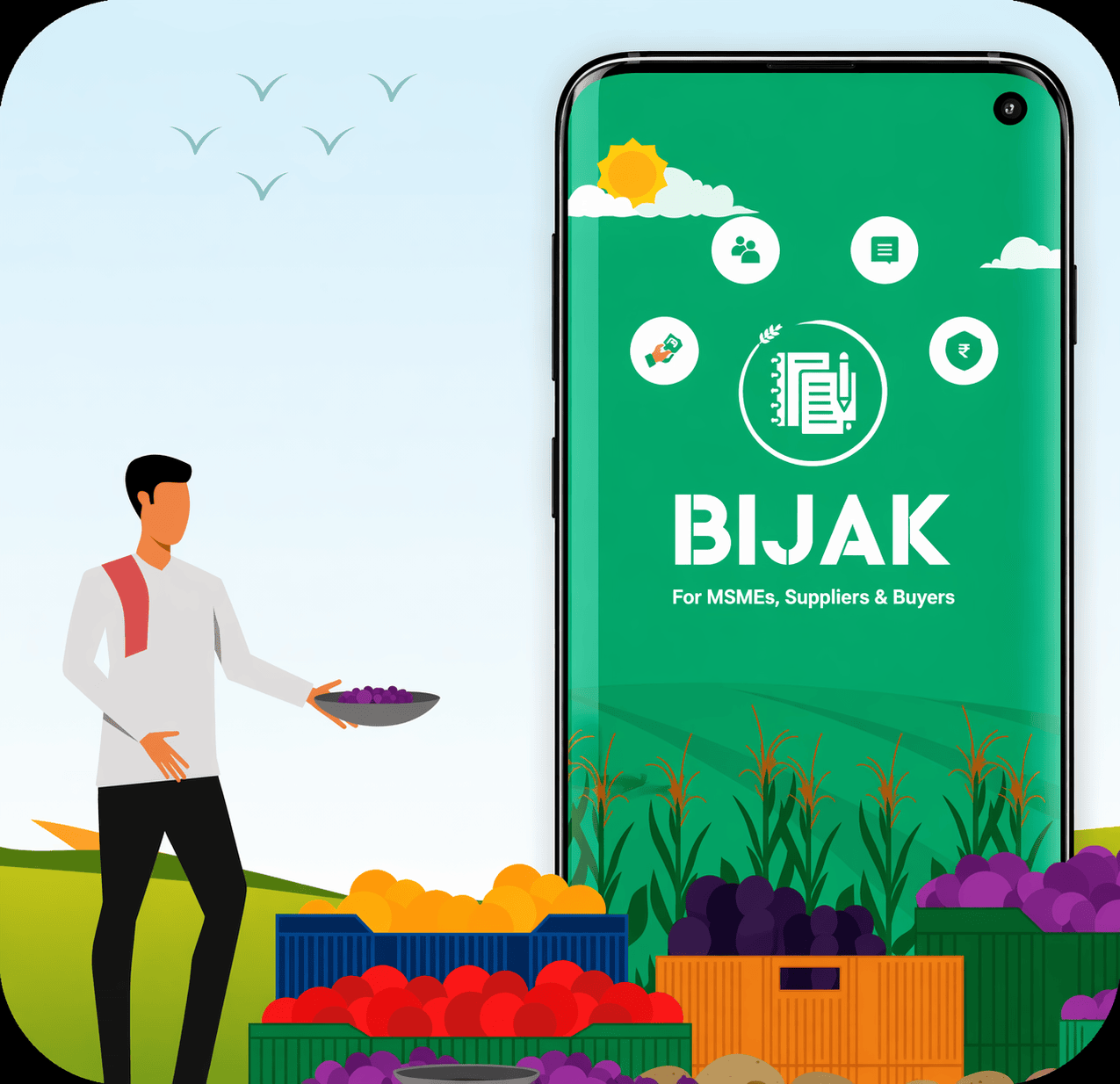
Case study · Bijak
Building for Bharat, agricultural trading on rural India's smartphones.
How we partnered with Bijak, a Sequoia-backed B2B agricultural trading platform, to build an Android app that works for farmers, traders, and wholesalers in rural India. On low-end devices. In low-connectivity environments. For users who may have never downloaded an app before.
At a glance
Industry
AgriTech / B2B Marketplace
Engagement
End-to-end Android development
Architecture
Offline-first
Duration
5.5 months
Release cadence
2 releases per week
Funding raised by client
$12M+ (Sequoia, Omnivore, Omidyar)
About the client
Connecting India's agricultural supply chain.
Bijak is a pan-Indian B2B platform that helps buyers and sellers of agricultural commodities come together. Their users include traders, wholesalers, and food processors who need to keep track of transactions, access pricing information, bring offline transactions online, and discover other traders.
Bijak was part of the Sequoia Surge Cohort 2 and has raised over $12 million from top investment firms including Sequoia Capital, Omnivore, and Omidyar Network India. When they approached us in 2019, they had a clear vision. But they faced a fundamental challenge: their target users were nothing like the typical app user.
The challenge
Treating the edge case as the norm.
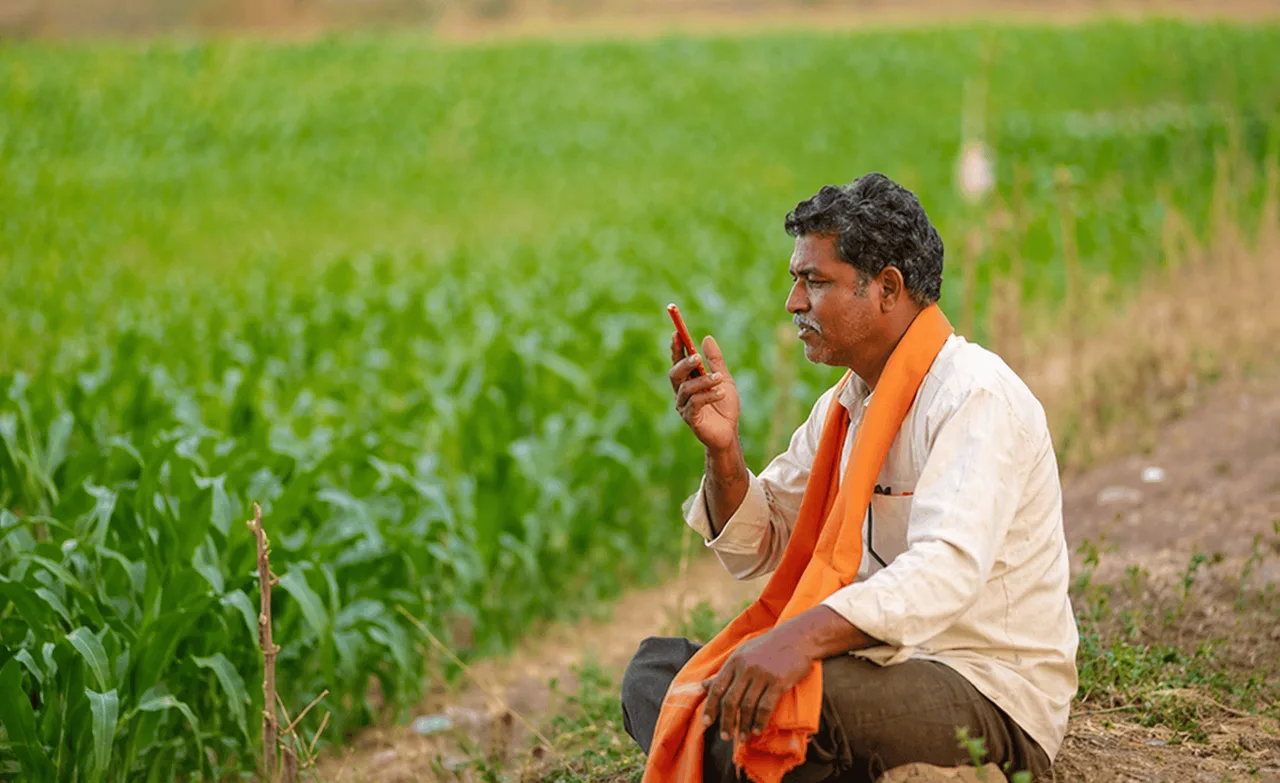
Most apps are built with a certain user in mind: someone with a modern smartphone, reliable internet, and years of experience navigating digital interfaces. Bijak's users were different.
Before writing a single line of code, we needed to deeply understand who we were building for. We conducted rigorous interviews with the Bijak team to understand the nature of transactions on the ground: who the users are, how they interact, how mandis work, how cash flows, and whether the app would change user behaviour from how they usually conducted business.
What we learned shaped every design and engineering decision. Everything that a typical app developer might consider an exception, low connectivity, low battery, limited digital literacy, had to be our baseline assumption.
Device quality
Low-end smartphones with small screens and low resolution.
Digital literacy
Many users had only ever used their phones for calls or WhatsApp.
Connectivity
Mobile networks ranging from 2G to 4G. WiFi was rare.
Battery life
Users went long hours without charging. GPS was a major drain.
Language
Users were more comfortable in Hindi than English.
Trust
Transactions were traditionally done face-to-face with handwritten records.
The solution
Product empathy meets engineering excellence.
We worked with Bijak end-to-end, from Android development to engineering and product practices. Our goal was to build an app that felt intuitive to users who had never downloaded an app before.
Simplified user experience
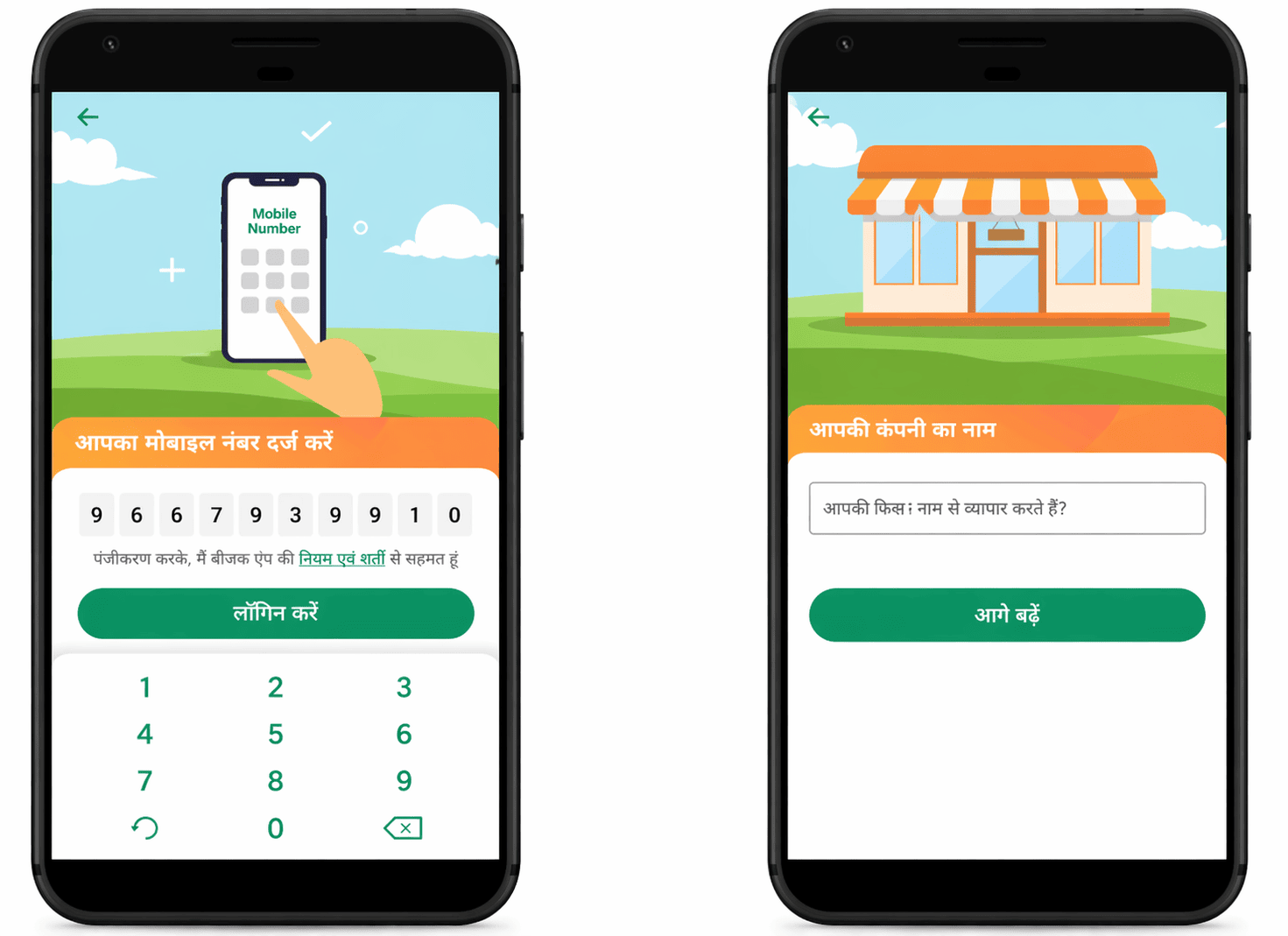
One input per screen. A custom numpad for numeric input. Hindi or English from the very first screen. Every flow designed to mirror real-world processes, so the app felt familiar, not foreign.
Offline-first architecture
All data stored locally on device. The app launches and operates fully in aeroplane mode. Transactions can be recorded anywhere, any time, and synced when connectivity returns. No feature depends on a constant internet connection.
Bringing offline transactions online
Users log payments and assurances manually, attaching photos of written slips, invoices, lorries, or pages from their khatas. Transactions are validated by Bijak's team, building a real-world reputation and rating system over time.
1:1 fidelity with real life
Familiar, not foreign.
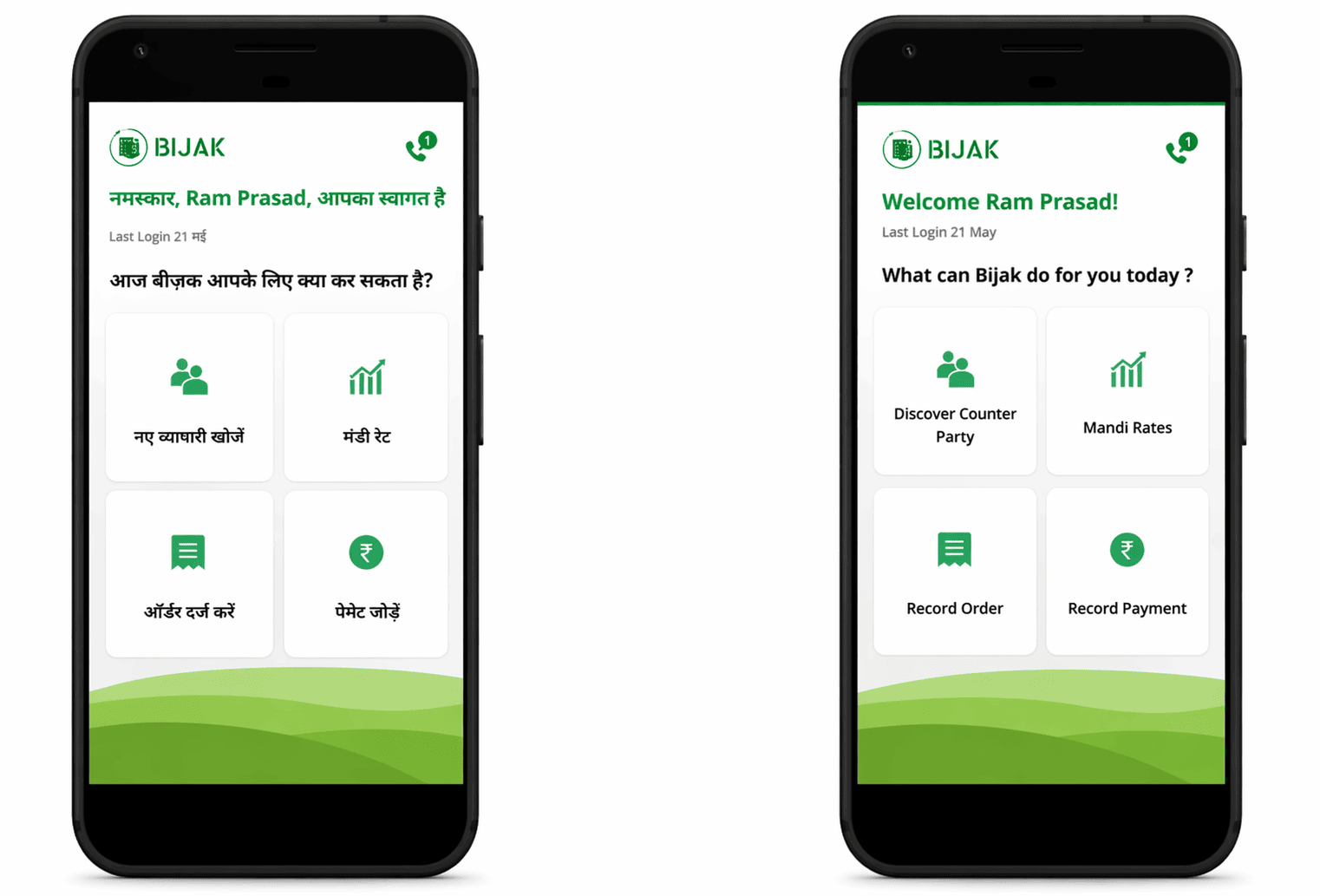
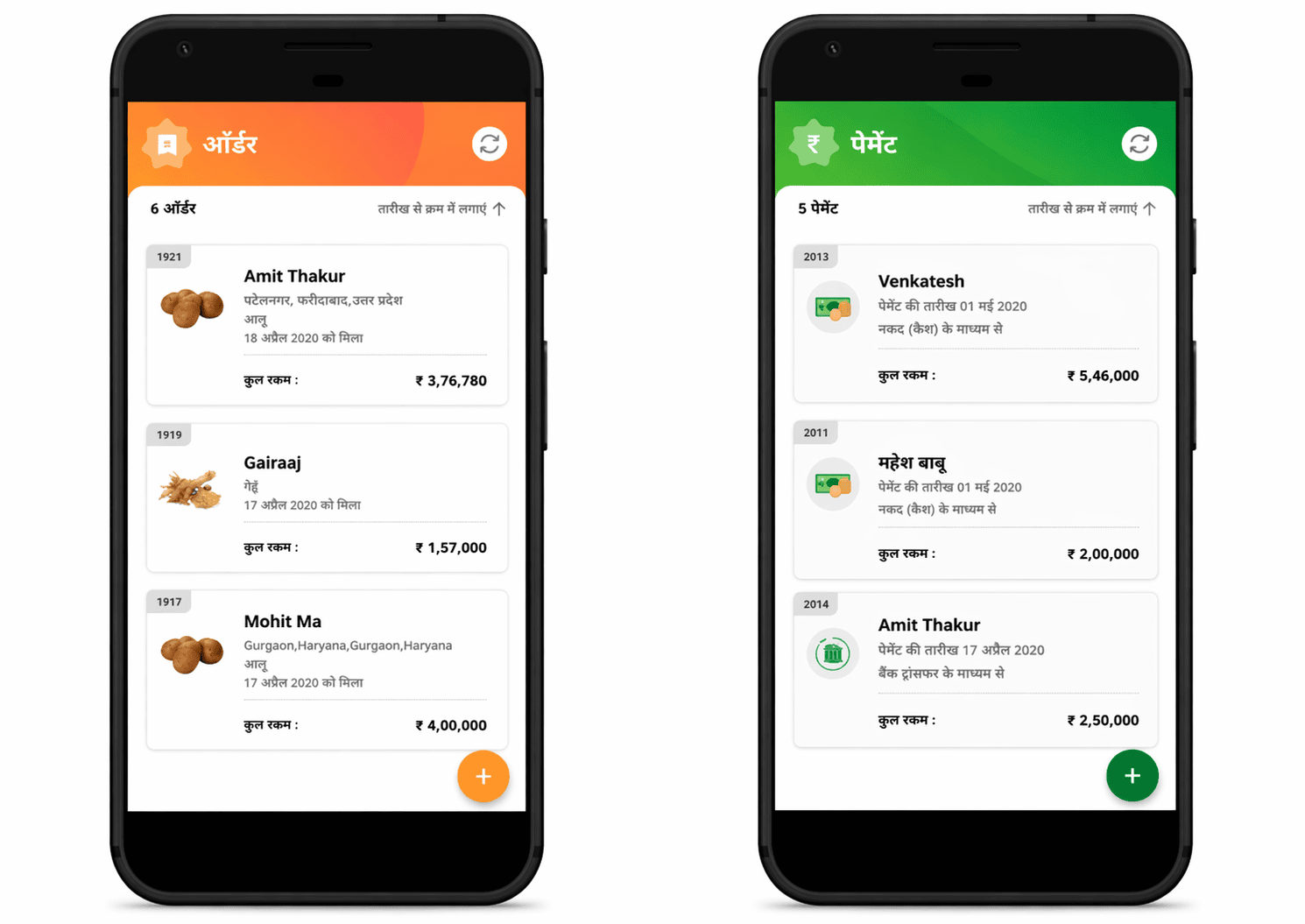
The same home screen, in two languages. If a trader was used to writing details in a khata, the app needed to feel like that, not like a generic dashboard. Large tap targets, clear icons, and language parity meant the experience was identical whether you tapped through in Hindi or English.
Discover counterparties. Check mandi rates. Record an order. Add a payment. Four core jobs, each a single tap from home.
Key features delivered
Every detail tuned for the most constrained user.
Multi-language support
Hindi and English available from the very first screen, ensuring the entire experience was accessible in the user's preferred language.
Simplified sign-up flow
Minimal text input, one field per screen, and a custom numpad for numeric entry, all designed for first-time app users.
Offline-first by default
Full functionality without internet. Local storage, sync when connected, and operation even in aeroplane mode.
Transaction recording with image proofs
Easy logging of trades with support for photos of invoices, khatas, lorries, and handwritten slips, bridging offline trust into the digital ledger.
Reputation and rating system
A transaction history that builds credibility for traders and farmers, enabling better decisions around credit and payouts.
Low-end device optimization
Designed for small screens, low resolution, limited processing power, and battery-conscious resource use.
The results
Real adoption. Real data quality. A real foundation for growth.
↑↑
Transaction recording
Traders began logging transactions on the app with greater frequency and volume, reducing the need for manual field data collection.
↓↓
Junk user data
Bad or unusable data, incorrect numbers, incomplete commodity details, and inaccurate locations, dropped sharply versus the previous version.
$12M+
Raised by Bijak
The app provided the technical foundation for Bijak's continued growth and fundraising from Sequoia, Omnivore, and Omidyar.
Our process
Two releases every week, for five and a half months.
We worked with Bijak for five and a half months, maintaining an intense release cadence of two releases per week. This rapid iteration allowed us to constantly examine our assumptions, test the app across real-world scenarios, and quickly incorporate feedback from the Bijak team and their users.
Building for low-end devices requires product empathy and engineering discipline. We built our testing practices around this as our starting point, ensuring every feature worked reliably under the constraints our users faced daily.
Why this matters
Building for Bharat.
In a vast country of different degrees of digital literacy, building an app that helps users in their business is not just a technical challenge. It is an exercise in empathy. The typical patterns of app development do not apply when your user has never downloaded an app, runs a phone with 1GB of RAM, works in areas with no WiFi, and trusts handwritten ledgers more than digital interfaces.
Whether your audience is in London or rural Rajasthan, we help startups build products that work in the real world.
Ready to build a product that works for your users?
Tell us about it. We'll reply within two business days with a clear next step.
Book a free discovery call